
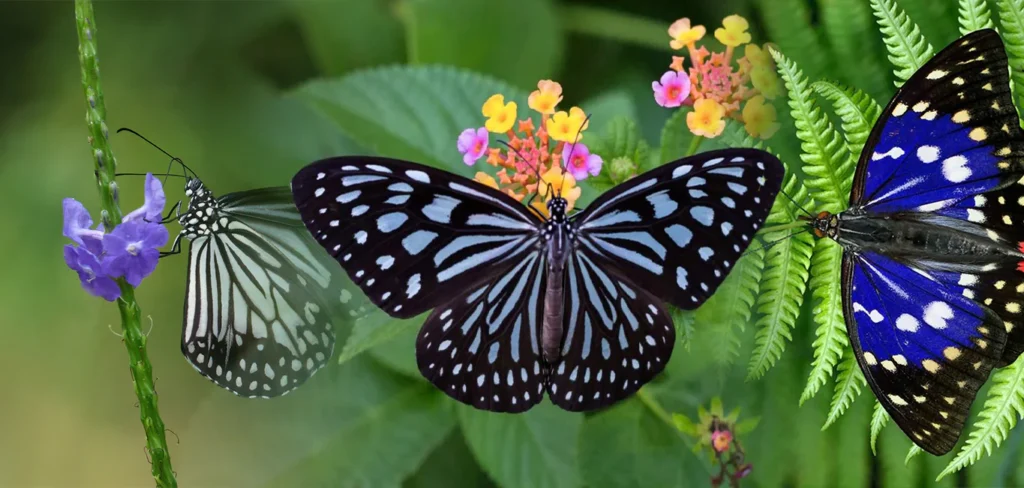
If birds are the music of Sinharaja, then butterflies are its moving art. While many visitors come for the feathers, a Sinharaja Butterfly Watching Tour offers a quieter, more delicate exploration of the forest’s “flying jewels.”
With over 50% of Sri Lanka’s endemic butterfly species found within this reserve, Sinharaja is the best place in the country to spot rare, high-canopy dwellers and colorful forest-floor species that you won’t find in your garden.
🦋 The “Big Five” of Sinharaja Butterflies
Out of the 245+ species in Sri Lanka, these are the ones every enthusiast hopes to see during a trek:
- Sri Lankan Birdwing (Endemic): The national butterfly of Sri Lanka. It’s a giant, stunning creature in black and neon yellow. With a wingspan of up to 135mm, it looks more like a small bird than an insect.
- Ceylon Tree Nymph (Endemic): Known as the “Forest Ghost.” It has large, translucent white wings with black spots and a unique, slow, floating flight pattern that makes it look like a piece of paper drifting in the wind.
- Red Spotted Duke (Endemic): A master of camouflage. Often found near the forest floor, it has beautiful olive-green wings decorated with distinct red spots.
- Blue Mormon: One of the largest and most vibrant butterflies in the forest. Its velvet-black wings are splashed with bright electric blue—it’s impossible to miss when it crosses a sunny clearing.
- Clipper: A fast, powerful flyer often seen near the waterfalls and streams. It has intricate lace-like patterns on its wings.
☀️ The Best Time for Sightings
Unlike birds, which are most active at the crack of dawn, butterflies are solar-powered.
- Optimal Window: 10:00 AM to 2:00 PM. Butterflies need the sun’s warmth to fly. You’ll often find them “puddling” (drinking minerals from damp sand) near riverbeds or basking in patches of sunlight that break through the canopy.
- The Season: The dry months of January to March and August to September are best. In heavy rain, butterflies hide under leaves and are nearly impossible to spot.
📍 Where to Go: The “Butterfly Trails”
While you can see butterflies anywhere in the forest, specific micro-habitats offer better chances:
- The River Banks (Pitadeniya Entrance): The damp rocks and sandy banks of the Gin Ganga river are prime spots for “mud-puddling,” where groups of butterflies gather to drink.
- The Forest Edges: Many species, like the Jezebel and Common Mormon, prefer the sunnier buffer zones where the forest meets the tea plantations.
- The Kudawa Bird & Butterfly Trail: This specific 2-hour trail is designed for low-impact walking and passes through diverse flora that attracts various larvae and adult species.
📸 Photography & Observation Tips
Butterfly photography in a rainforest is notoriously tricky due to the “dappled” light (patches of bright sun and deep shadow).
- Macro Lens is Key: Most forest butterflies are small and shy. A 100mm macro lens allows you to capture the scales on their wings without getting so close that you startle them.
- Look for Host Plants: Experienced guides will point out specific plants like Aristolochia (vines), which are the primary food source for Birdwing caterpillars. If you find the plant, the butterfly is usually nearby.
- Patience Near Water: If you find a group of butterflies on the ground near a stream, sit still for 10 minutes. They will eventually get used to your presence and allow you to get incredibly close.
📊 Tour Comparison: Birding vs. Butterfly Watching
| Feature | Bird Watching Tour | Butterfly Watching Tour |
| Start Time | 06:00 AM (Dawn) | 09:30 AM (Mid-morning) |
| Focus Area | High Canopy / Dense Undergrowth | Sunny Clearings / River Banks |
| Activity Level | Constant walking/tracking | Slow-paced / Observation-heavy |
| Difficulty | Moderate (Early hours) | Easy (Sunnier, flatter paths) |
🛡️ Quick Tips for 2026 Travelers
- Wear Neutral Colors: Bright white or neon clothing can startle butterflies. Stick to greens and browns to blend into the foliage.
- Don’t Use Perfume: Strong scents can interfere with the butterflies’ natural pheromones and tracking abilities.
- Ask for a “Naturalist”: When booking at the gate, specifically ask for a guide who knows lepidoptera (butterflies). While all guides know birds, only a few are specialists in identifying the 50+ tiny “Blues” and “Swifts” found in the undergrowth.