
Beyond the Wings: The Heart of Sinharaja Wildlife Tours
A wildlife tour in Sinharaja is more than just a walk; it’s an immersion into a 11,000-hectare living laboratory where evolution has run wild for millennia.
While the “flying jewels” dominate the midday sun, the rest of the forest’s residents create a spectacle of survival and synergy that you won’t find anywhere else on Earth.
🐦 The Phenomenon: The “Bird Wave”
Sinharaja is world-famous for the Mixed-Species Feeding Flocks. This is a cooperative hunting strategy where different bird species travel together to flush out insects.
- The Leader: The Greater Racket-tailed Drongo usually leads the pack, acting as the “alarm system” for the group.
- The Crowd Favorites: Look for the Sri Lanka Blue Magpie (stunning azure and chestnut feathers) and the Red-faced Malkoha, a shy canopy-dweller with a striking crimson mask.
- The Strategy: To see a wave, you must be patient. The forest will be silent for an hour, and suddenly, the trees will vibrate with the calls of 30-40 birds from 10 different species passing through in a whirlwind of color.
🦎 The “Hidden World” of Reptiles & Amphibians
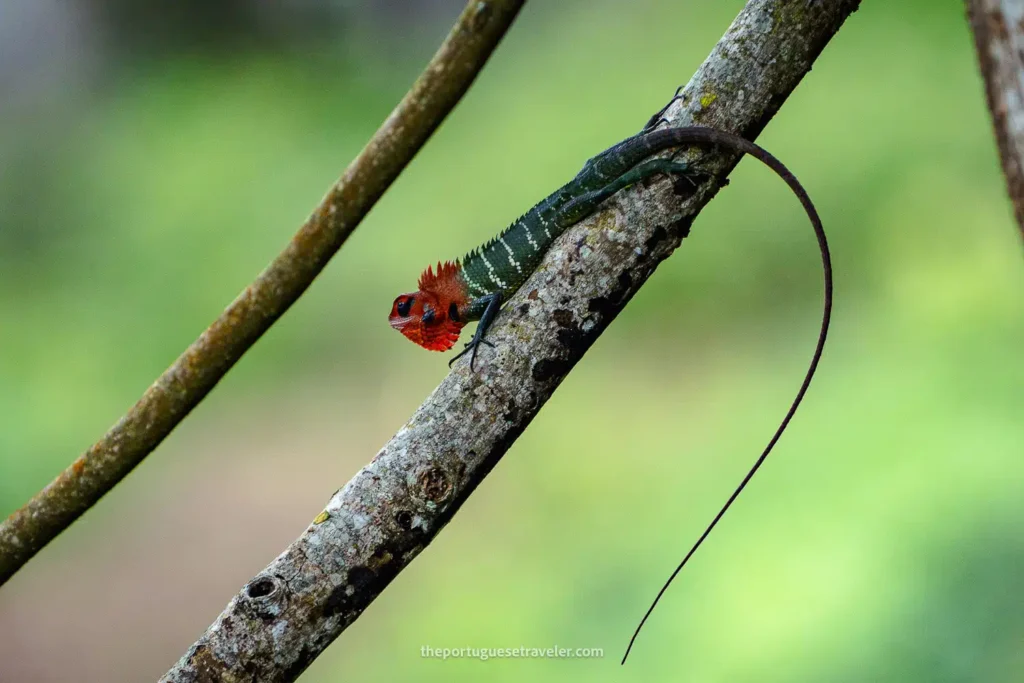
For those who look closely at the mossy trunks and damp leaf litter, Sinharaja reveals a prehistoric world. Over 80% of the reptiles found here are found nowhere else on the planet.
- Hump-nosed Lizards: Often found perched vertically on thin saplings, perfectly camouflaged against the bark.
- Green Pit Vipers: These sluggish, beautiful snakes are a photographer’s dream. They sit motionless for days, draped like emerald necklaces over low-hanging branches.
- Tree Frogs: If you take a night tour (permitted in buffer zones), the forest glows with the eyes of endemic tree frogs, some no larger than a fingernail.
🕒 The “Wildlife Clock”: Planning Your Day
A successful wildlife tour is all about timing. Because Sinharaja is a rainforest, the inhabitants follow a strict biological schedule:
| Time Slot | Primary Target | Why? |
| 06:00 AM – 09:00 AM | Endemic Birds | The “Morning Chorus” is when birds are most vocal and active. |
| 10:00 AM – 02:00 PM | Butterflies & Dragonflies | The sun hits the canopy, “fueling” the insects. |
| 03:00 PM – 05:30 PM | Mammals & Primates | Look up for the Purple-faced Leaf Langur moving through the trees. |
🎒 Essential Gear for the 2026 Explorer
To enjoy your wildlife tour without the “bite” of the rainforest, come prepared with these non-negotiables:
- Leech Socks: These are your best friends. Sinharaja is famous for its thirsty leeches, especially after a light drizzle. Most tour operators provide them, but having your own ensures a snug fit.
- Rain Poncho: It isn’t called a rainforest for nothing. Even in the dry season, a 10-minute downpour is common.
- Binoculars (8×42): While butterflies are close, the Blue Magpies and Langurs stay high in the giants of the Dipterocarp trees.
🌿 Sustainable Trekking: Leave Only Footprints
Sinharaja is a UNESCO World Heritage Site. When booking your wildlife tour, ensure your operator follows “Low-Impact” principles. Stick to the designated paths to avoid crushing the delicate orchids and rare ferns that house the very larvae your favorite butterflies depend on.
Pro Tip: “The forest speaks to those who listen.” Tell your guide to stop every 500 meters and just stand still. Often, the most incredible wildlife encounters happen when you stop looking for them and let them come to you.